Starter

y=1/4x^2 + -3/4x + -1|black
(-1, 0)|label:-1|black
(0, -1)|label:-1|black
(4, 0)|label:4|black
2 roots    y=a(x1)(x4)\text{2 roots} \implies y=a(x--1)(x-4) At x=0,y=1    1=a(0+1)(04)1=4a1/4=a\begin{gathered} \text{At }x=0, y=-1 \\[4pt] \begin{align} \implies -1 &= a(0+1)(0-4) \\ -1 &= -4a \\ 1/4 &= a \end{align} \end{gathered} y=14(x+1)(x4)y=14(x23x4)y=14x234x1a=14, b=34, c=1\begin{gathered} \begin{align} y &= \frac{1}{4}(x+1)(x-4) \\ y &= \frac{1}{4}(x^{2}-3x-4) \\ y &= \frac{1}{4}x^{2} - \frac{3}{4}x - 1 \\ \end{align} \\[4pt] \therefore a = \frac{1}{4},\ b = -\frac{3}{4},\ c = -1 \end{gathered}

The Discriminant

Info

If you square any real number, the result is greater or equal to zero. This means that if yy is negative, y\sqrt{ y } cannot be a real number.

x=b±b24acdiscriminant2a x=\frac{-b \pm \sqrt{ \overbrace{ b^{2} - 4ac }^{ discriminant } }}{2a}

b24acb^{2} - 4ac is called the discriminant, sometimes denoted by Δ\Delta. There are three options for the outcomes of the discriminant:

{b24ac>0Two distinct real rootsb24ac=0One repeated rootb24aclt;0No real roots\begin{cases} b^{2} - 4ac > 0 & \text{Two distinct real roots} \\ b^{2} - 4ac = 0 & \text{One repeated root} \\ b^{2} - 4ac < 0 & \text{No real roots} \end{cases}

quad-discr-graphs.excalidraw

Example 13

Find the values of kk for which f(x)=x2+kx+9f(x) = x^{2} + kx + 9 has equal roots.

b24ac=k24190=k23636=k2±36=k±6=k\begin{align} b^{2} - 4ac &= k^{2} - 4 \cdot 1 \cdot 9 \\ 0 &= k^{2} - 36 \\ 36 &= k^2 \\ \pm \sqrt{ 36 } &= k \\ \pm 6 &= k \end{align}

Example 14

Find the range of values of kk for which x2+4x+k=0x^{2} + 4x + k = 0 has two distinct real solutions.

b24ac=4241k=424k=164k\begin{align} b^{2} - 4ac &= 4^{2} - 4 \cdot 1 \cdot k \\ &= 4^{2} - 4k \\ &= 16 - 4k \\ \end{align} 164k>04k>16klt;4\begin{align} 16 - 4k &> 0 \\ -4k &> -16 \\ k &< 4 \end{align}

E/P 7

h(x)=2x2+(k+4)x+kh(x) = 2x^{2} + (k+4)x + k, where kk is a real constant.

Find the discriminant of h(x)h(x) in terms of kk

b24ac=(k+4)242k=(k+4)28k=k2+8k+168k=k2+16\begin{align} b^{2} - 4ac &= (k+4)^{2} - 4 \cdot 2 \cdot k \\ &= (k+4)^{2} - 8k \\ &= k^{2} + 8k + 16 - 8k \\ &=k^{2} + 16 \end{align}

Hence or otherwise, prove that h(x)h(x) has two distinct real roots for all values of kk

There are two roots as k2+1616>0\text{There are two roots as } k^{2} + 16 \geq 16 > 0

Modelling with Quadratics

Info

A mathematical model is a mathematical description of a real-life situation. They use the langauge and tools of mathematics to represent and explore real-life patterns and relationships, and to predict what is going to happen next.

They can be simple or complicated, and their results can be approximate or exact. Sometimes a model is only valid under certain circumstances or for a limited range of inputs.

Quadratic functions can be used to model a range of practical contexts, including projectile motion.

Example 15

Example

A spear is thrown over level ground from the top of a tower. The height, in metres, of the spear above the ground after tt seconds is modelled by the function: h(t)=12.25+14.7t4.9t20h(t) = 12.25 + 14.7t - 4.9t^{2} \geq 0

  1. Interpret the meaning of the constant term 12.2512.25 in the model. It is the height at which the spear was thrown from
  2. After how many seconds does the spear hit the ground? 0=12.25+14.7t4.9t2t=b±b24ac2at=14.7±14.7244.912.2524.9t=0.6793.679The spear hits the ground after 3.697 seconds as time can’t be negative\begin{gathered} \begin{align} 0 &= 12.25+14.7t-4.9t^{2} \\ t &= \frac{-b \pm \sqrt{ b^{2} - 4ac }}{2a} \\ \\ t &= \frac{-14.7 \pm \sqrt{ 14.7^{2} - 4 \cdot -4.9 \cdot 12.25 }}{2 \cdot -4.9} \\ t &= -0.679 \lor 3.679 \\ \end{align} \\[4pt] \therefore \text{The spear hits the ground after 3.697 seconds as time can't be negative} \end{gathered}
  3. Write h(t)h(t) in the form AB(tC)2A-B(t-C)^{2}, where AA, BB and CC are constants to be found. 4.9t2+14.7t+12.25=4.9(t23t)+12.25=4.9[(t1.5)22.25]+12.25=4.9(t1.5)2+12.25+11.025=23.2754.9(t1.5)2\begin{align} -4.9t^{2} + 14.7t + 12.25 &= -4.9(t^{2} - 3t) + 12.25 \\ &= -4.9\left[\left(t-1.5\right)^{2} - 2.25\right] + 12.25 \\ &= -4.9(t-1.5)^{2} + 12.25 + 11.025 \\ &= 23.275 - 4.9(t-1.5)^{2} \\[4pt] \end{align}
  4. Using your answer to part 3 or otherwise, find the maximum height of the spear above the ground, and the time at which this maximum height is reached. Turning point is (1.5, 23.275)\text{Turning point is (1.5, 23.275)}

Exercise 2H

Example

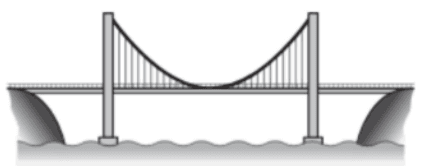
The diagram shows a section of a suspension bridge carrying a road over water. quad-model-bridge The height of the cables above water level in metres can be modelled by the function h(x)=0.00012x2+200h(x) = 0.00012x^{2} + 200, where xx is the displacement in metres from the center of the bridge.

  1. Interpret the meaning of thee constant term 200200 in the model It is the height of the cables above water level at the center of the bridge
  2. Use the model to find the two values of xx at which the height is 346 m346\text{ m}. 346=0.00012x2+200146=0.00012x236500003=x2±1103xx=11031103\begin{gathered} \begin{align} 346 &= 0.00012x^{2} + 200 \\ 146 &= 0.00012x^{2} \\ \frac{3650000}{3} &= x^{2} \\ \pm 1103 &\approx x \\ \end{align} \\[4pt] \therefore x = -1103 \lor 1103 \end{gathered}
  3. Given that the towers at each end are 364 m364\text{ m} tall, use your answer to part 2 to calculate the length of the bridge to the nearest metre. let x2=365000030.0001236500003=146The length of the bridge to the nearest metre is 146 m\begin{gathered} \text{let }x^2 = \frac{3650000}{3} \\[4pt] \begin{align} 0.00012 \cdot \frac{3650000}{3} = 146 \end{align} \\[4pt] \therefore \text{The length of the bridge to the nearest metre is $146$ m} \end{gathered}

Challenge 1

Accident investigators are studying the stopping distance of a particular car.

When the car is travelling at 20 mph, its stopping distance is 6 feet. When the car is travelling at 30 mph, its stopping distance is 14 feet. When the car is travelling at 40 mph, its stopping distance is 24 feet. The investigator suggests that the stopping distance in feet, dd is a quadratic function of the speed in miles per hour, ss.

  1. Given that d(s)=as2+bs+cd(s) = as^2 + bs + c, find the values of the constants aa, bb and cc.

    6=a(20)2+b(20)+c14=a(30)2+b(30)+c24=a(40)2+b(40)+c\begin{align} 6 &= a(20)^2 + b(20) + c \tag{1} \\ 14 &= a(30)^2 + b(30) + c \tag{2} \\ 24 &= a(40)^2 + b(40) + c \tag{3} \\[4pt] \end{align} Rearrange (1)\text{Rearrange (1)} \\[4pt] 6=a(20)2+b(20)+cc=6a(20)2b(20)\begin{align} 6 &= a(20)^2 + b(20) + c \\ c &= 6 - a(20)^2 - b(20) \tag{4} \end{align} Substitute (4) into (2)\text{Substitute (4) into (2)} \\[4pt] 14=a(30)2+b(30)+6a(20)2b(20)14=900a+30b+6400a20b0=500a+10b810b=500a8b=500a810\begin{align} 14 &= a(30)^2 + b(30) + 6 - a(20)^2 - b(20) \\ 14 &= 900a + 30b + 6 - 400a - 20b \\ 0 &= 500a + 10b - 8 \\ -10b &= 500a - 8 \\ b &= \frac{500a - 8}{-10} \tag{5} \end{align} Substitute (4) and (5) into (3)\text{Substitute (4) and (5) into (3)} 24=a(40)2+500a810(40)+6a(20)2b(20)24=a(40)2+500a810(40)+6a(20)2500a810(20)24=1600a+20000a32010+6400a+20(500a8)100=1200a+20000a10+32010+6+10000a+16010240=1200a2000a+32+624+10000a10+160100=800a+14+1000a160=200a22=200aa=0.01\begin{align} 24 &= a(40)^2 + \frac{500a - 8}{-10}(40) + 6 - a(20)^2 - b(20) \\ 24 &= a(40)^2 + \frac{500a - 8}{-10}(40) + 6 - a(20)^2 - \frac{500a-8}{-10}(20) \\ 24 &= 1600a + \frac{20000a - 320}{-10} + 6 - 400a + \frac{-20(500a-8)}{-10} \\ 0 &= 1200a + \frac{20000a}{-10} + \frac{-320}{-10} + 6 + \frac{-10000a+160}{-10} - 24\\ 0 &= 1200a - 2000a + 32 + 6 - 24 + \frac{-10000a}{-10} + \frac{160}{-10} \\ 0 &= -800a + 14 + 1000a - 16 \\ 0 &= 200a - 2 \\ 2 &= 200a \\ a &= \boxed{ 0.01 } \end{align} Substitute a into (5)\text{Substitute $a$ into (5)} b=5000.01810b=0.3\begin{align} b &= \frac{500 \cdot 0.01 - 8}{-10} \\ b &= \boxed{ 0.3 } \end{align} Substitute a and b into (4)\text{Substitute $a$ and $b$ into (4)} c=6a(20)2b(20)c=60.012020.320c=4\begin{align} c &= 6 - a(20)^2-b(20) \\ c &= 6 - 0.01 \cdot 20^2 - 0.3 \cdot 20 \\ c &= \boxed{ -4 } \end{align} a=0.01, b=0.3, c=4\therefore a=0.01,\ b=0.3,\ c=-4
  2. At an accident scene, a car has left behind a skid that is 20 feet long. Use your model to calculate the speed that this car was going at before the accident.
    d(s)=as2+bs+cd(s)=0.01s2+0.3s420=0.01s2+0.3s40=0.01s2+0.324s=b±b24ac2as=0.3±0.3240.01420.01s=4010\begin{align} d(s) &= as^2 + bs + c \\ d(s) &= 0.01s^2 + 0.3s - 4 \\ 20 &= 0.01s^2 + 0.3s - 4 \\ 0 &= 0.01s^2 + 0.3 - 24 \\ s &= \frac{-b \pm \sqrt{ b^2 - 4ac }}{2a} \\ s &= \frac{-0.3 \pm \sqrt{ 0.3^2 - 4 \cdot 0.01 \cdot -4 }}{2 \cdot 0.01} \\ s &= -40 \lor 10 \end{align}
Built with LogoFlowershow