Expanding Binomials

Pascal’s Triangle

binom-1 binom-2

Example 1

(x+2y)3=1(x)3(2y)0+3(x)2(2y)1+3(x)1(2y)2+1(x)0(2y)3=x3+6x2y+12xy2+8y3\begin{align} (x+2y)^3 &= 1(x)^3(2y)^0 + 3(x)^2(2y)^1 + 3(x)^1(2y)^2 + 1(x)^0(2y)^3 \\ &= x^3 + 6x^2y + 12xy^2 + 8y^3 \end{align}

Example 2

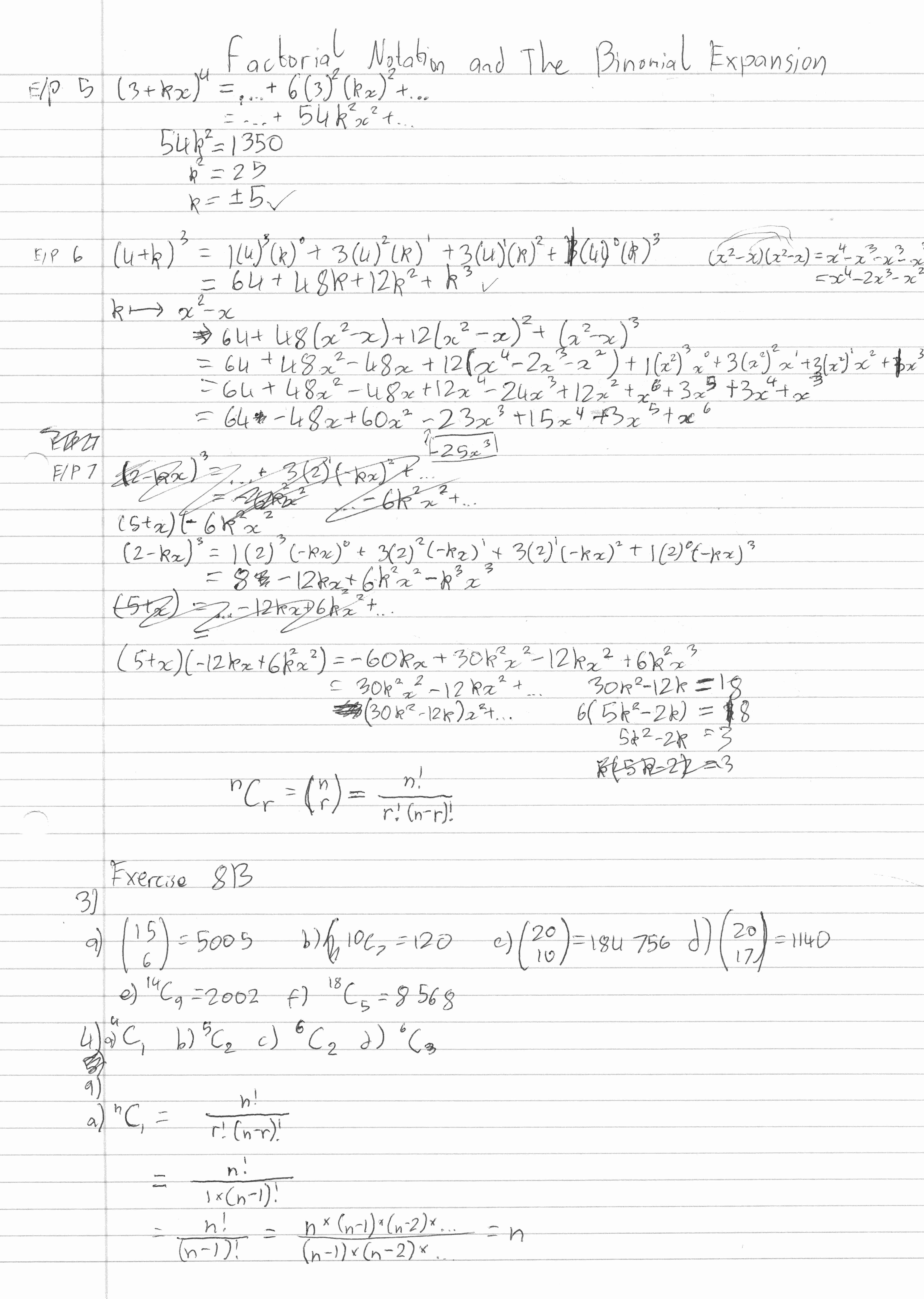
The coefficient of x2x^2 in the expansion of (2cx)3(2-cx)^3 is 294294. Find the possible value(s) of the constant cc

(2cx)3294x23(2)(cx)2=294x26c2x2=294x26c2=294c2=49c=±7\begin{align} (2-cx)^3 &\rightarrow 294x^2 \\ 3(2)(-cx)^2 &= 294x^2 \\ 6c^2x^2 &= 294x^2 \\ 6c^2 &= 294 \\ c^2 &= 49 \\ c &= \pm 7 \end{align}

Example 3

Expand (4+k)3(4+k)^3. Hence or otherwise, write down the expansion of (4+x2x)3(4+x^2-x)^3 in ascending powers of x.

Step 1: Expand

(4+k)3=1(4)5(k)0+3(4)1(k)2+1(4)0(k)3=64+48k+12k2+k3\begin{align} (4+k)^{3} &= 1(4)^{5}(k)^{0} + 3(4)^{1}(k)^{2} + 1(4)^{0}(k)^{3} \\ &= 64 + 48k + 12k^{2} + k^{3} \end{align}

Step 2: Substitute

Let k=x2x    64+48(x2x)+12(x2x)2+(x2x)3=64+48(x2x)+12(x42x3+x2)+(x63x5+3x4x3)=64+48x248x+12x424x3+12x2+x63x5+3x4x3=x63x5+15x425x3+60x248x+64\begin{align} &\text{Let }k = x^{2} - x\\ \\ &\implies 64 + 48(x^{2} - x) + 12(x^{2} - x)^{2} + (x^{2} - x)^{3} \\ &= 64 + 48(x^2 - x) + 12(x^4 - 2x^3 + x^2) + (x^6 - 3x^5 + 3x^4 - x^3) \\ &= 64 + 48x^{2} - 48x + 12x^{4} - 24x^{3} + 12x^{2} + x^{6} - 3x^{5} + 3x^{4} - x^{3} \\ &= x^{6} - 3x^{5} + 15x^{4} - 25x^{3} + 60x^{2} - 48x + 64 \end{align}

Choose

Info

nCr^nC_{r} gives the number on Pascal’s triangle where nn is the row and rr is the term.

{}^nC_{r} = {n \choose r} = \frac{n!}{r! (n-r)!}

Basic examples

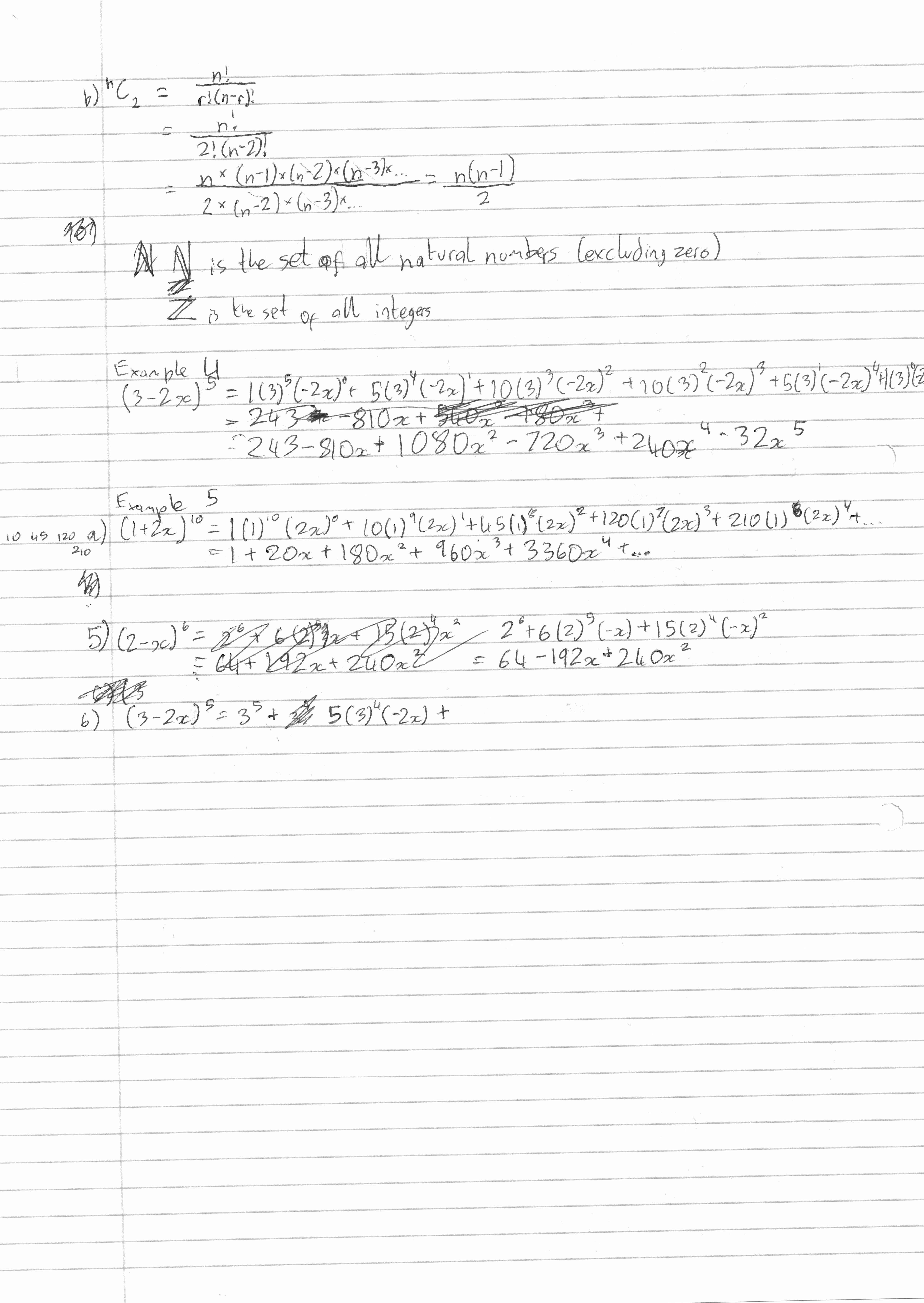
(156)=5005(107)=600600\begin{align} \binom{15}{6} &= 5005 \\ \binom{10}{7} &= 600600 \end{align} (32x)5=(100)(1)10(2x)0+(101)(1)9(2x)1+(102)(1)8(2x)2+=1(1)10(2x)0+10(1)9(2x)1+45(1)8(2x)2=1+20x+180x2+960x3+\begin{align} (3-2x)^{5} &= {10 \choose 0}(1)^{10}(2x)^{0} + {10 \choose 1}(1)^{9}(2x)^{1} + {10 \choose 2}(1)^{8}(2x)^{2} + \dots \\ &= 1(1)^{10}(2x)^{0} + 10(1)^{9}(2x)^{1} + 45(1)^{8}(2x)^{2} \\ &= 1 + 20x + 180x^{2} + 960x^{3} + \dots \end{align}

Given that (5013)=50!13!a!{50 \choose 13} = \frac{50!}{13!a!}, write down the value of aa

(nr)=n!r!(nr)!(5013)=50!13!a!    a=(nr)a=(5013)a=37\begin{align} {n \choose r} &= \frac{n!}{r!(n-r)!} \\ {50 \choose 13} &= \frac{50!}{13!a!} \\[6pt] \implies a &= (n-r) \\ a &= (50 - 13) \\ a &= \boxed{ 37 } \end{align}

Given that (35p)=35!p!18!{35 \choose p} = \frac{35!}{p!18!}, write down the value of pp

(nr)=n!r!(nr)!(35p)=35!p!18!n=35r=p(nr)=18(35p)=18p=17p=17\begin{align} {n \choose r} &= \frac{n!}{r!(n-r)!} \\ {35 \choose p} &= \frac{35!}{p!18!} \\[6pt] n &= 35 \\ r &= p \\ (n-r) &= 18 \\ (35 - p) &= 18 \\[6pt] -p &= -17 \\ p &= \boxed{ 17 } \end{align}

Prove (n1)=n\binom{n}{1} = n

(n1)=n!r!(nr)!=n!1(n1)!=n!(n1)!=n(n1)(n2)(n1)(n2)=n\begin{align} \binom{n}{1} &= \frac{n!}{r!(n-r)!} \\ &= \frac{n!}{1 (n-1)!} \\ &= \frac{n!}{(n-1)!} \\ &= \frac{n \cancel{ (n-1) } \cancel{ (n-2) } \dots}{\cancel{ (n-1) } \cancel{ (n-2) } \dots} \\ &= n \end{align}

Prove (n2)=n(n1)2{n \choose 2} = \frac{n(n-1)}{2}

(n2)=n!r!(nr)!=n!2!(n2)!=n(n1)(n2)(n3)2(n2)(n3)=n(n1)2\begin{align} {n \choose 2} &= \frac{n!}{r!(n-r)!} \\ &= \frac{n!}{2!(n-2)!} \\ &= \frac{n (n-1) \cancel{ (n-2) } \cancel{ (n-3) } \dots}{2 \cancel{ (n-2) } \cancel{ (n-3) }\dots} \\ &= \frac{n(n-1)}{2} \end{align}

Binomial Estimation

Find the first three terms in the expansion of (1+2x)10(1+2x)^{10}

(1+2x)10=1+10(2x)+1092!(2x)2+=1+20x+454x2+=1+20x+180x2+\begin{align} (1+2x)^{10} &= 1 + 10(2x) + \frac{10 \cdot 9}{2!}(2x)^2 + \dots \\ &= 1 + 20x + 45 \cdot 4x^2 + \dots \\ &= 1 + 20x + 180x^2 + \dots \end{align}

Use your expansion to approximate 1.20101.20^{10}. Give your answer to an appropriate number of decimal places.

1+2x=1.022x=0.02x=0.01(1.02)10=1+200.01+1800.0001+=1+0.3+0.018+=1.22 (2 d.p.)\begin{align} 1+2x &= 1.02 \\ 2x &= 0.02 \\ x &= 0.01 \\ \\ (1.02)^{10} &= 1 + 20 \cdot 0.01 + 180 \cdot 0.0001 + \dots \\ &= 1 + 0.3 + 0.018 + \dots \\ &= 1.22\text{ (2 d.p.)} \end{align}

binom-c-1 binom-c-2

Built with LogoFlowershow