2x+x−6Let y=x2y2+y−6yyy1.52.25∴x=2.25∨4=0=0=2⋅2−1±12−4⋅2⋅−6=1.5∨Cannot be negative−2=x=x=xx8−17x4+16Let y=x4y2−17x+160yx4xxx4x∴x=±2,±1=0=0=(y−16)(y−1)=16∨1=16=±416=±2=1=±1
12 (EP)
f(x)=4kx2+(4k+2)x+1, where k is a real constant.
Find the discriminant in terms of k
16k2+4
Functions
Info
A function is a mathematical relationship that maps each value of a set of inputs to a single output. The notation f(x) is used to represent a function of x.
The set of possible inputs is called the domain.
The set of possible outputs is called the range.
The roots are the values of x for which f(x)=0
y=x^2+1
Domain=RRange={y∈R∣y≥1}
Example 8
The functions f and g are given by f(x)=2x−10 and g(x)=x2−9,x∈R.
Find the values of f(5) and g(10)
f(5)g(10)=2⋅5−10=0=102−9=100−9=91
Example 9
f(x)=x2+6x−5,x∈R
x2+6x−5Roots014±14−3±14Minimum value(x+3)2(x+3)2−14∴Minimum is −14=(x+3)2−9−5=(x+3)2−14=(x+3)2−14=(x+3)2=x+3=x≥0≥−14
Find gradients of the chords joining the point (4,16) to the points with coordinates:
(5,25)m(4.5,20.25)m(4.1,16.81)m(4.01,16.0801)m(4+h,(4+h)2)m=5−425−16=9=4.5−420.25−16=8.5=4.1−416.81−16=8.10000000000002=4.01−416.0801−16=8.01000000000033=4+h−4(4+h)2−16=hh2+8h+16−16=hh2+8h=h+8h→0lim(h+8)=8∴Gradient is 8
Info
The gradient function, or derivative, of the curve y=f(x) is written as f′(x) or dxdy.
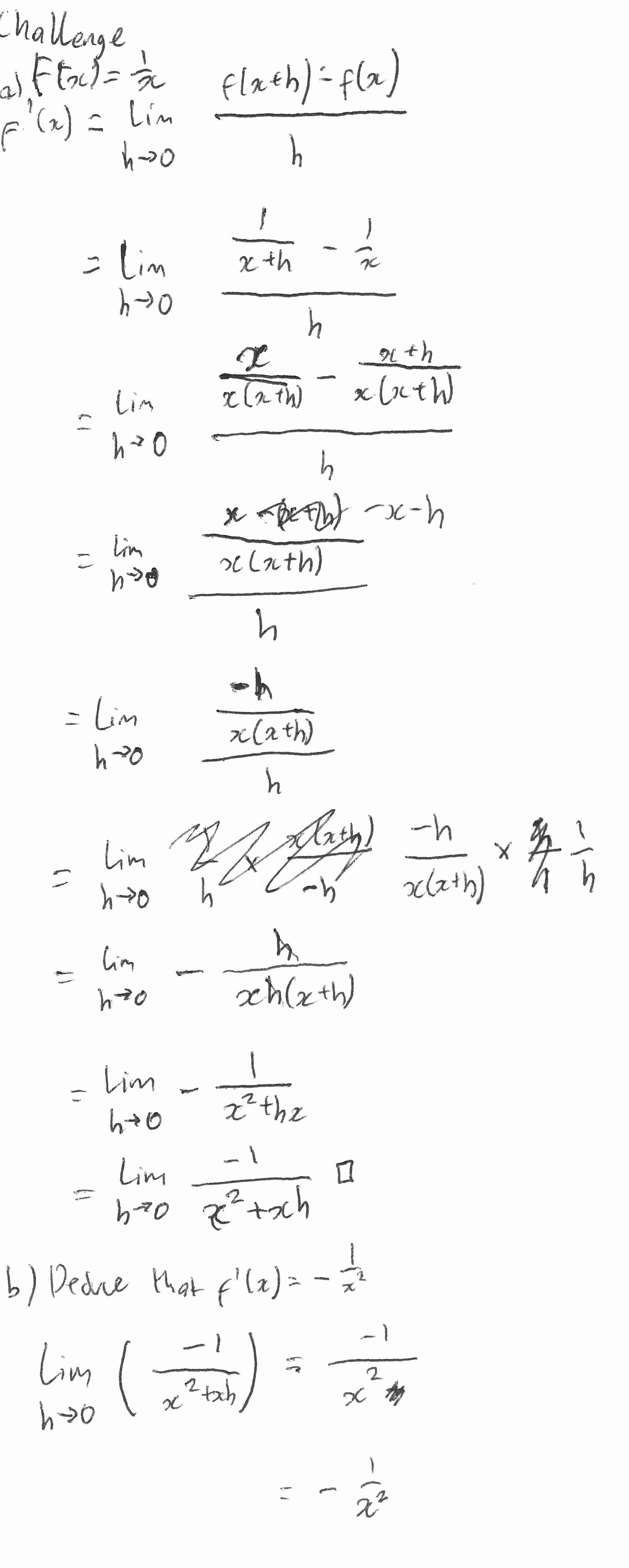
f′(x)=h→0limhf(x+h)−f(x)
The gradient function can be used to find the gradient of the curve for any value of x.
Example 2
In this example, we work out the gradient at a specific point. This means we aim for a specific numerical value (gradient at a point).
The point A with coordinates (4,16) lies on the curve with equation y=x2. At point A the curve has the gradient g.
In this example, we work out the gradient at any random point of the curve. That means we aim for an expression in terms of x (gradient function). This can be used to evaluate (by substituting the point’s x coordinate) the gradient at any point on the graph.
Prove, from first principles, that the derivative of x3 is 3x2
ABm=f′(x)=(x,x3)=(x+h,(x+h)3)=h→0limx+h−x(x+h)3−x3=h→0limhx3+3x2h+3xh2+h3+x3=h→0limh3x2h+3xh2+h3=h→0limhh(3x2+3xh+h2)=h→0lim(3x2+3xh+h2)As h→0,3xh→0 and h2→0So f′(x)=3x2
General Derivitive Formula
(xn)1=nxn−1
Because:
h→0limh(x+h)n−xn=nxn−1
For all real values of n, and for constant a:
If f(x)=xn then f′(x)=nxn−1
If y=xn then dxdy=nxn−1
If f(x)=axn then f′(x)=anxn−1
If y=axn then dxdy=anxn−1
Challenge
Differentiating Quadratics
If y=f(x)±g(x), then dxdy=f′(x)±g′(x)
Gradients, Tangents, and Normals
The equation of a straight line with gradient m that passes through the point (x1,y1) is y−y1=m(x−x1)
Example
Work out the equation fo the line that goes through A(2,3) with a gradient of −1
You can use the derivative to find the equation of the tangent to a curve at a given point. On the curve with the equation y=f(x), the gradient of the tangent at a point A with x-coordinate a will be f′(a)
The gradient of a curve at A(x1,y1):
m=x−x1y−y1f=f′(x2)m=tanθ
The tangent to the curve y=f(x) at the point with coordinates (a,f(a)) has equation
y−f(a)=f′(a)(x−a)
The normal to the curve y=f(x) at the point with coordinates (a,f(a)) has equation
y−f(a)=−f′(a)1(x−a)
Increasing and Decreasing Functions
The function f(x) is increasing on the interval [a,b] if f′(x)≥0 for all values of x such that a < x < b.
The function f(x) is decreasing on the interval [a,b] if f′x(x)≤0 for all values of x such that a < x < b
y=x^4 - 2x^2
(-1, -1)
(1, -1)
The function f(x)=x4−2x2 is increasing where [−1,0]∪[1,+∞), and