Polynomial Division

Method 1

Find (4x417x2+4)÷(2x+1)(4x^4 - 17x^2 + 4) \div (2x + 1)

2x3x28x+4 2x+1)4x4+0x317x2+0x+44x4+2x317x2+0x+42x317x2+0x+42x3x2+0x+416x2+0x+416x28x+48x+48x+40\begin{array}{r} 2x^3 - x^2 - 8x + 4 \ \\ 2x + 1 \mathbin{\overline{\smash{\big)}\, 4x^4 + 0x^3 - 17x^2 + 0x + 4}} \\ \underline{4x^4 + 2x^3 \phantom{- 17x^2 + 0x + 4}} \\ -2x^3 - 17x^2 \phantom{+ 0x + 4} \\ \underline{-2x^3 - x^2 \phantom{+ 0x + 4}} \\ -16x^2 + 0x \phantom{+ 4} \\ \underline{-16x^2 - 8x \phantom{+ 4}} \\ 8x + 4 \\ \underline{8x + 4} \\ 0 \end{array}

So 4x417x2+4=(2x+1)(2x3x28x+4)4x^4 - 17x^2 + 4 = (2x + 1)(2x^3 - x^2 - 8x + 4)

Method 2

Only works if divisor is a factor

Divide x3+2x217x+6x^3 + 2x^2 - 17x + 6 by (x3)(x-3)

x3+2x217x+6=(x3)(ax2+bc+c)a=13c=6c=22=b3a2=b35=b\begin{align} x^3 + 2x^2 - 17x + 6 &= (x-3)(ax^2+bc+c) \\ \\ a&=1 \\ \\ -3c&=6 \\ c&=-2 \\ \\ 2&=b-3a \\ 2&=b-3 \\ 5&=b \end{align}

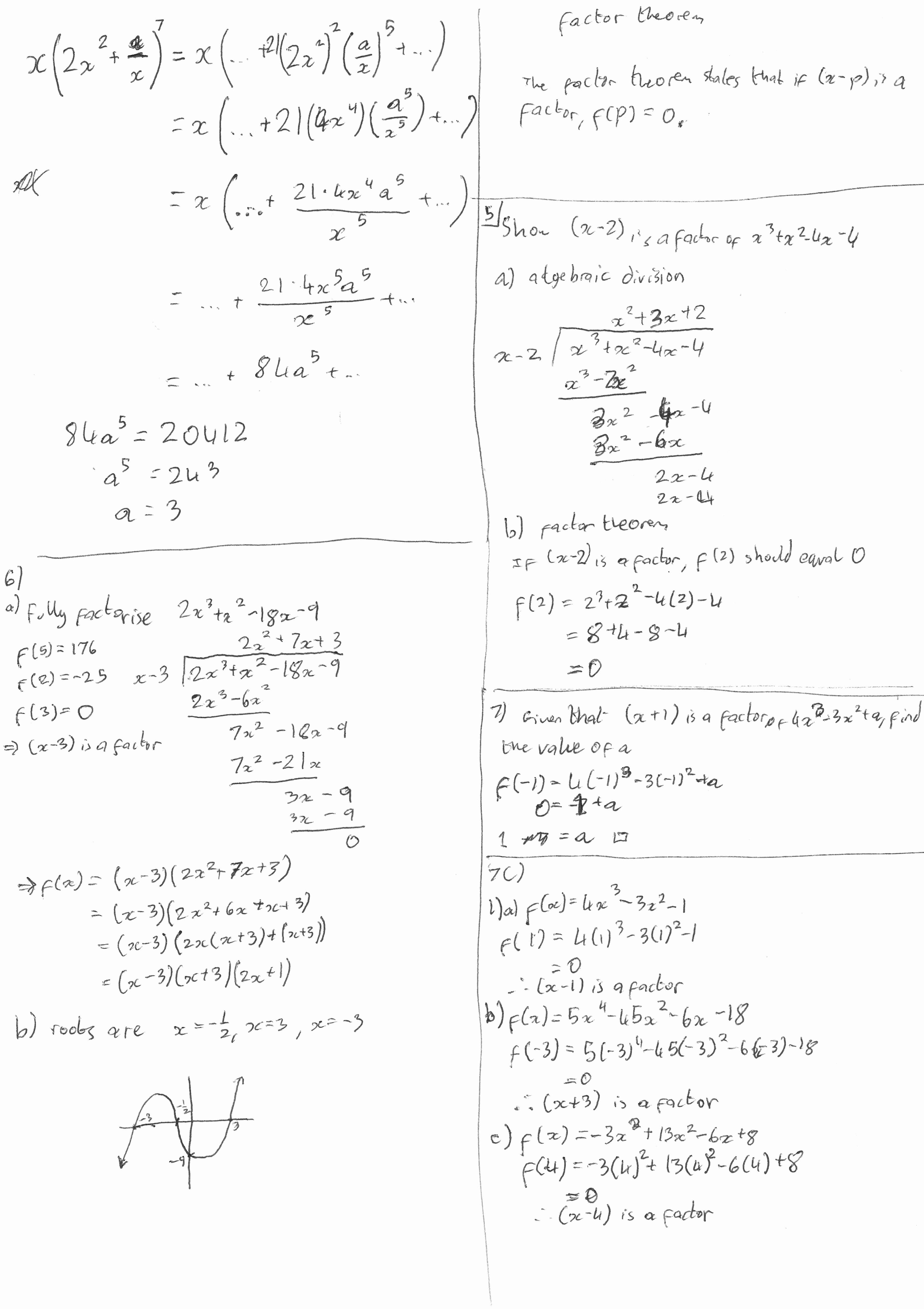
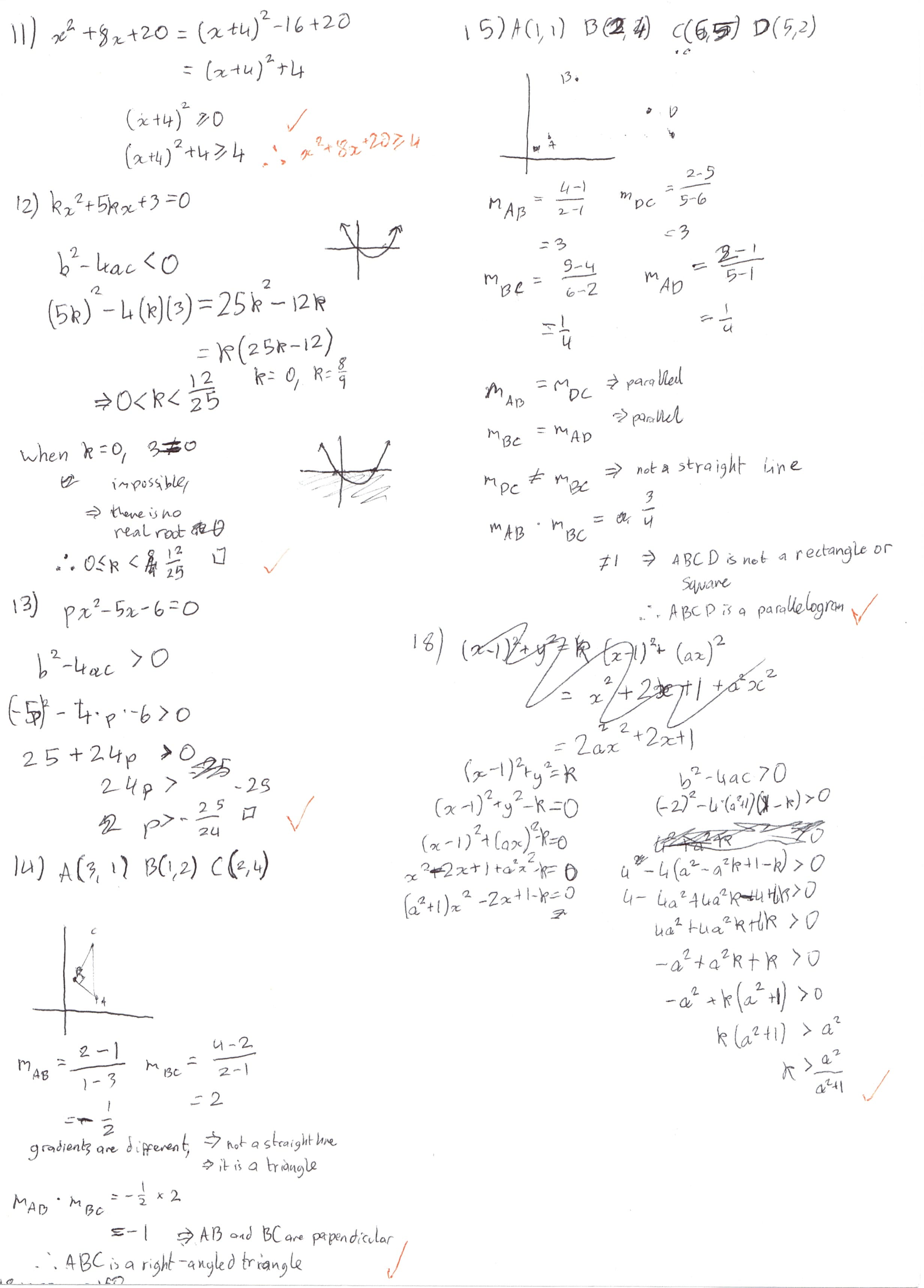
am-polynom-1 am-polynom-2

Homework

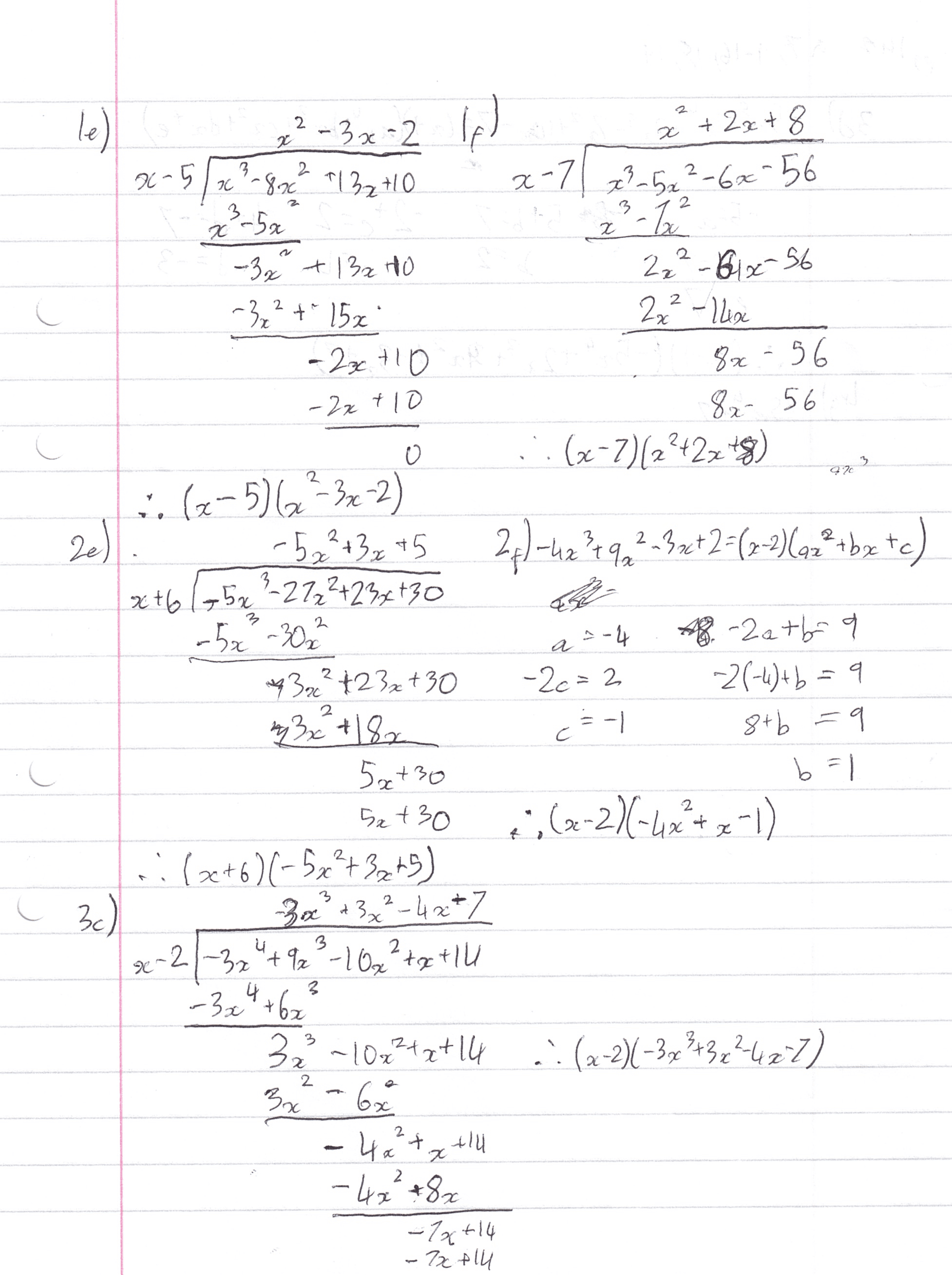
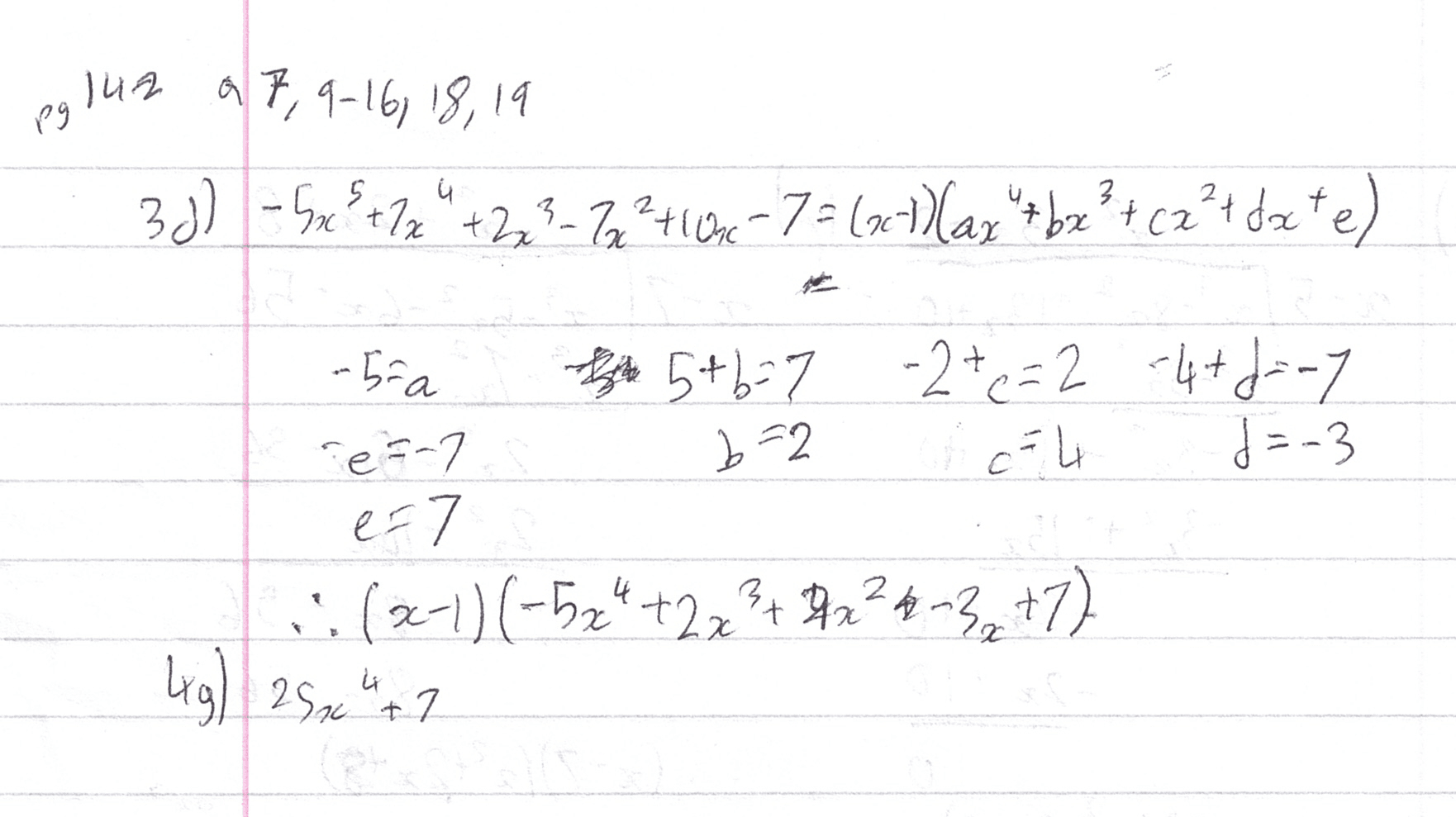
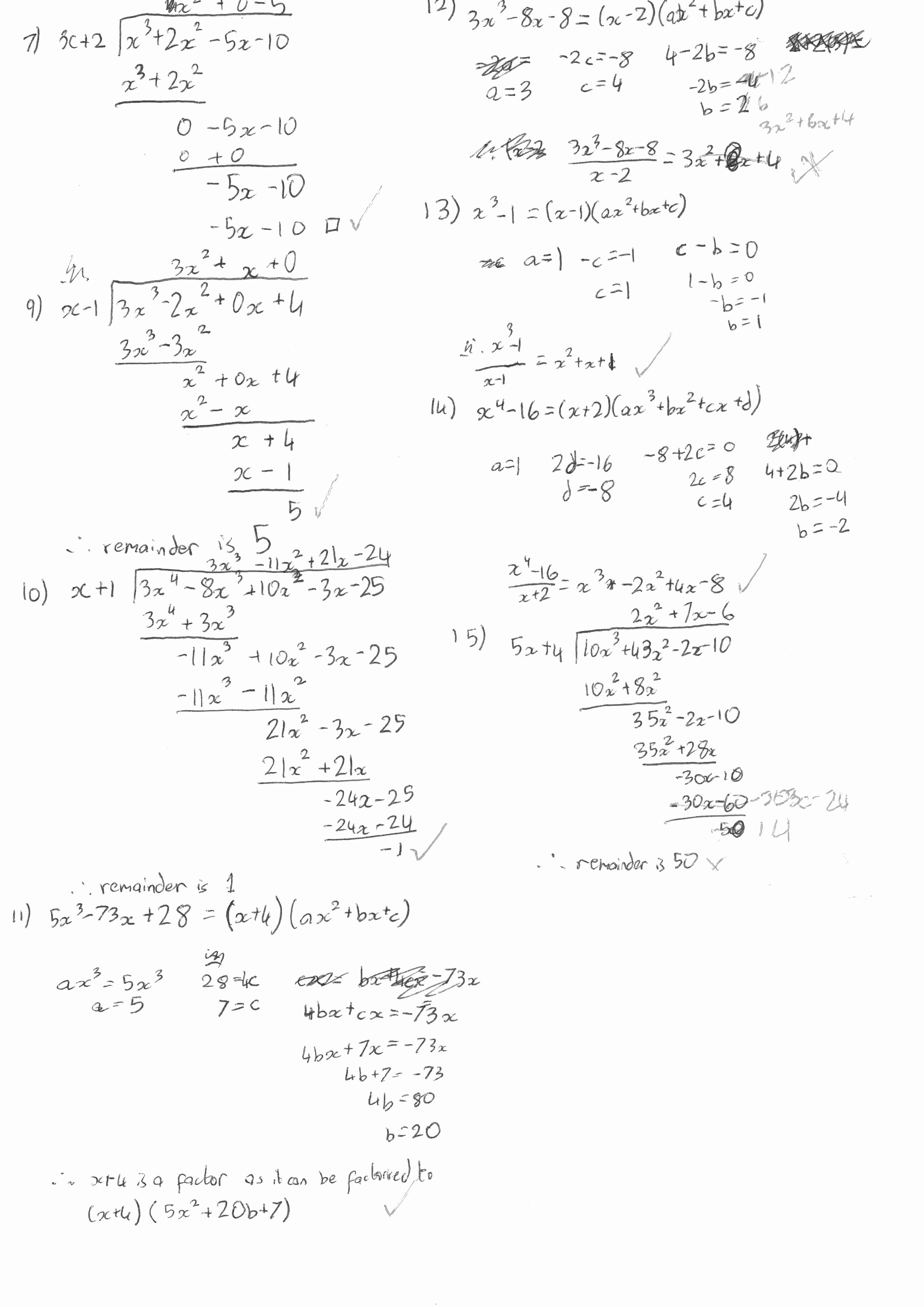
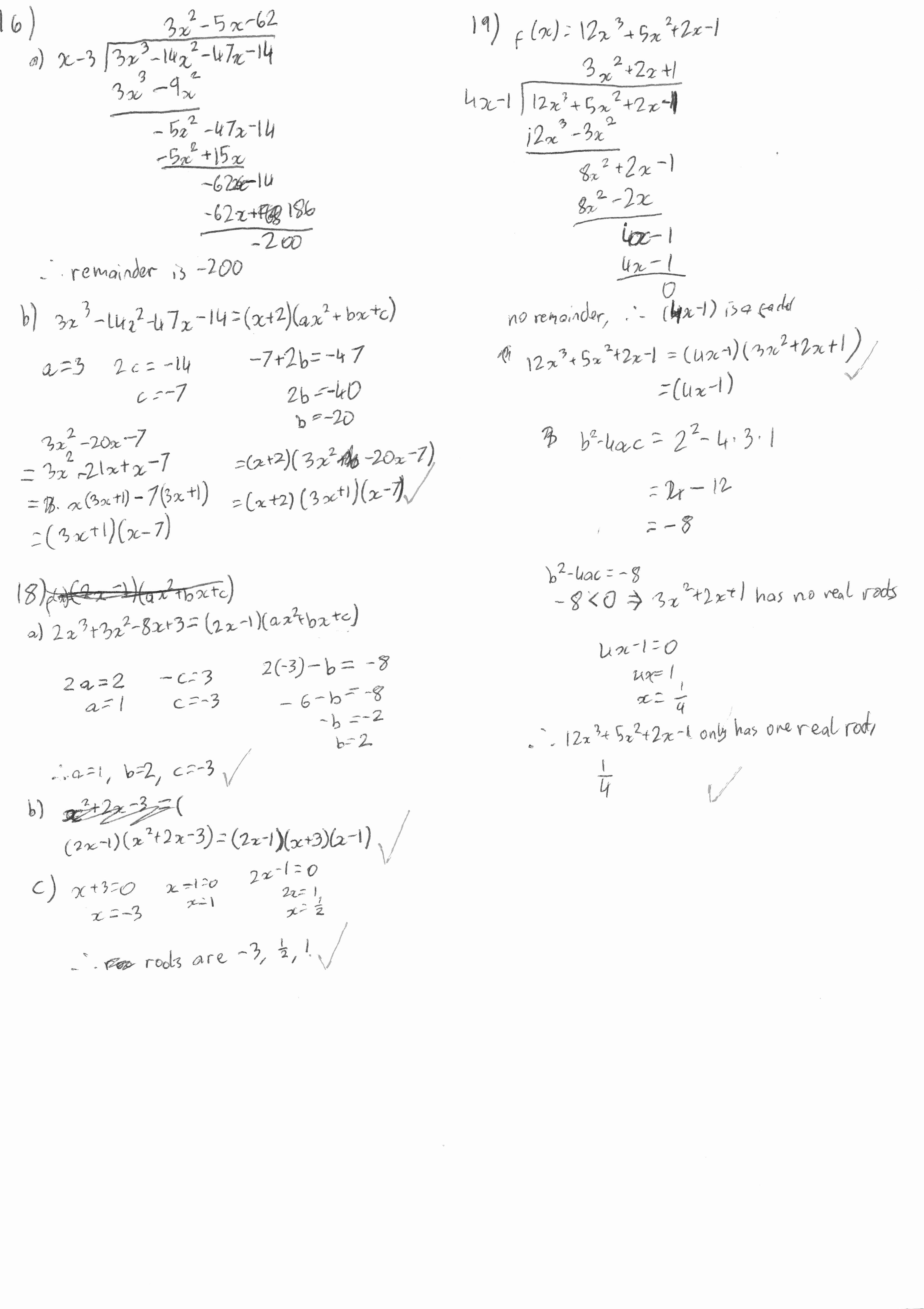
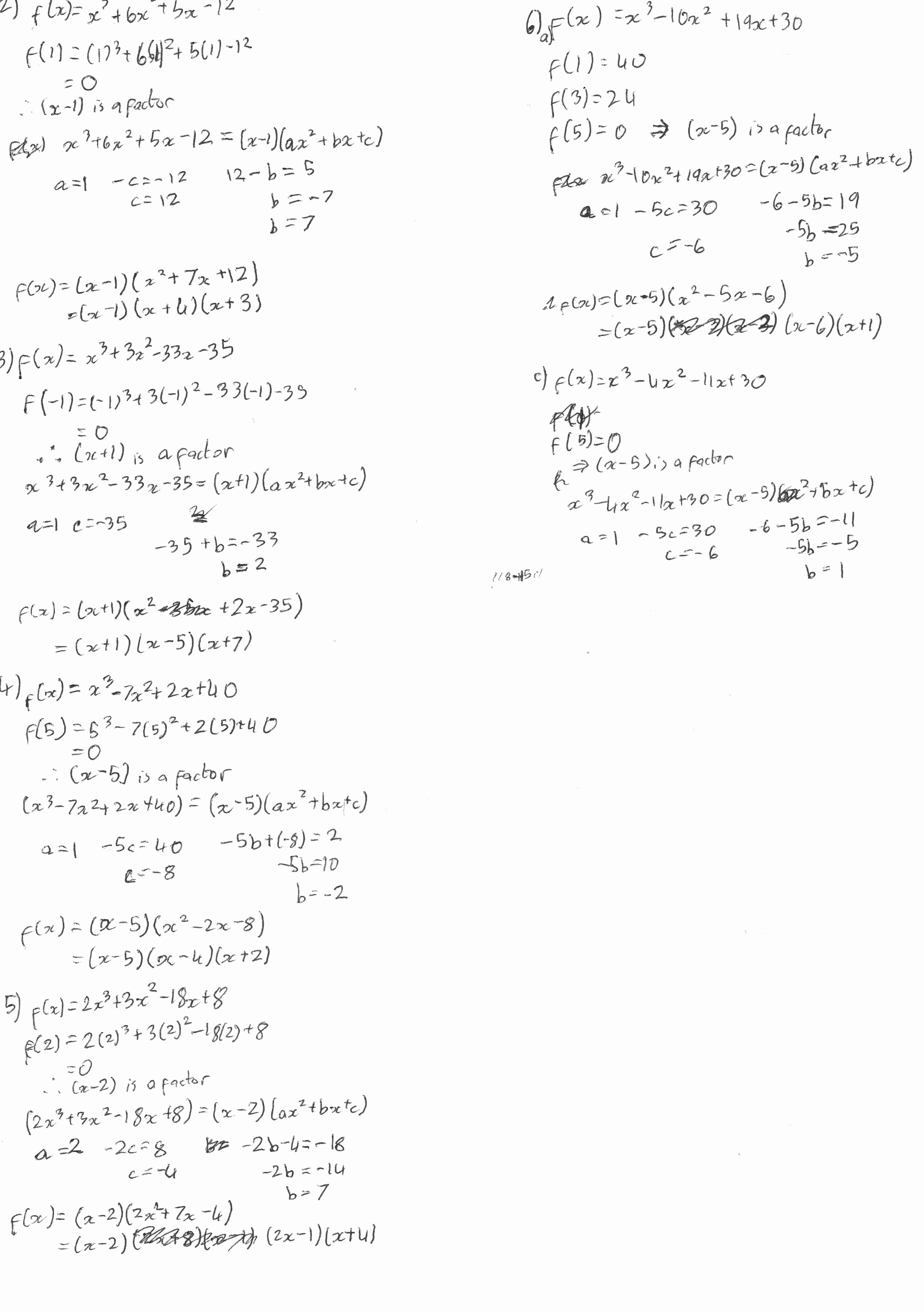
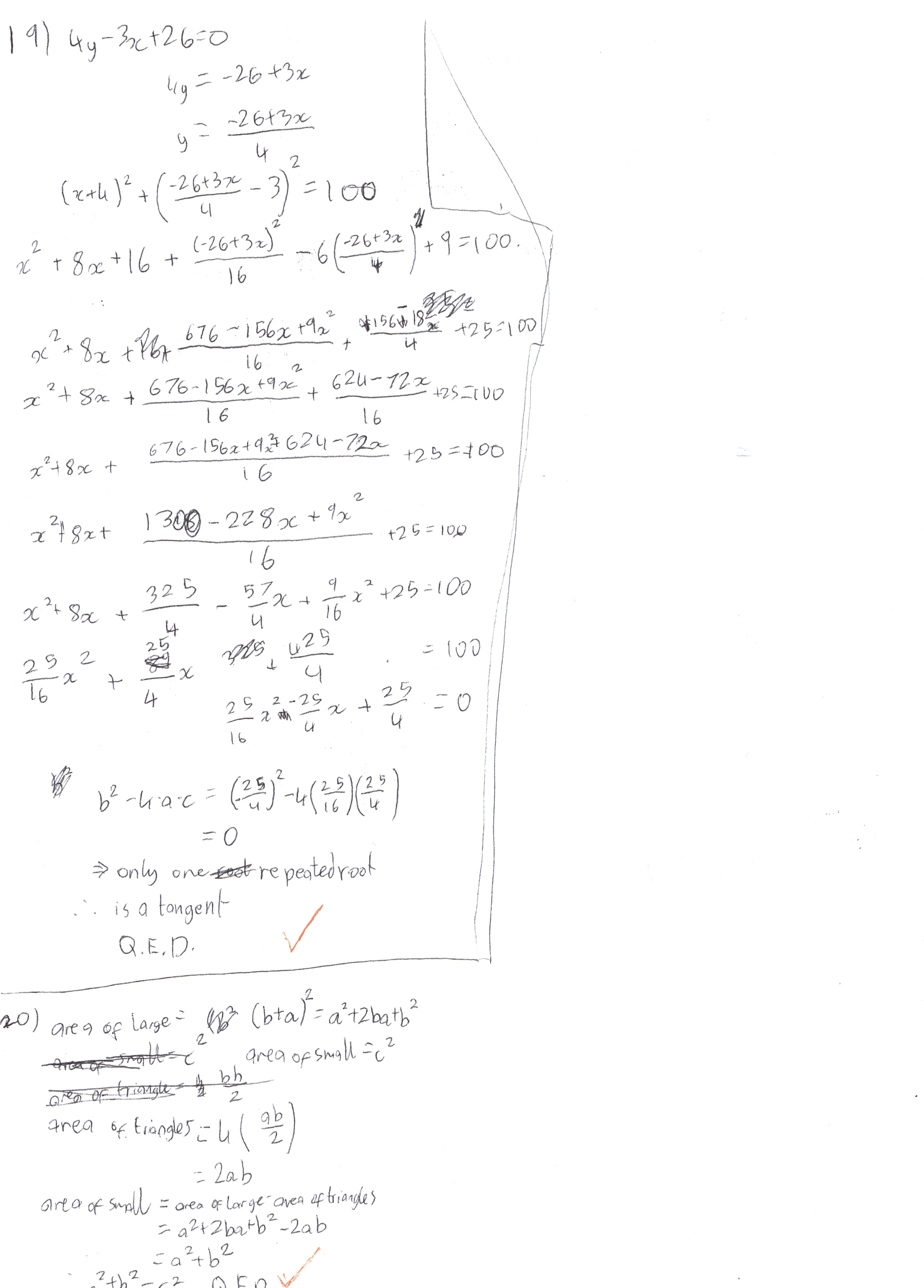
am-polynom-hw-f am-polynom-hw-b

Factor Theorem

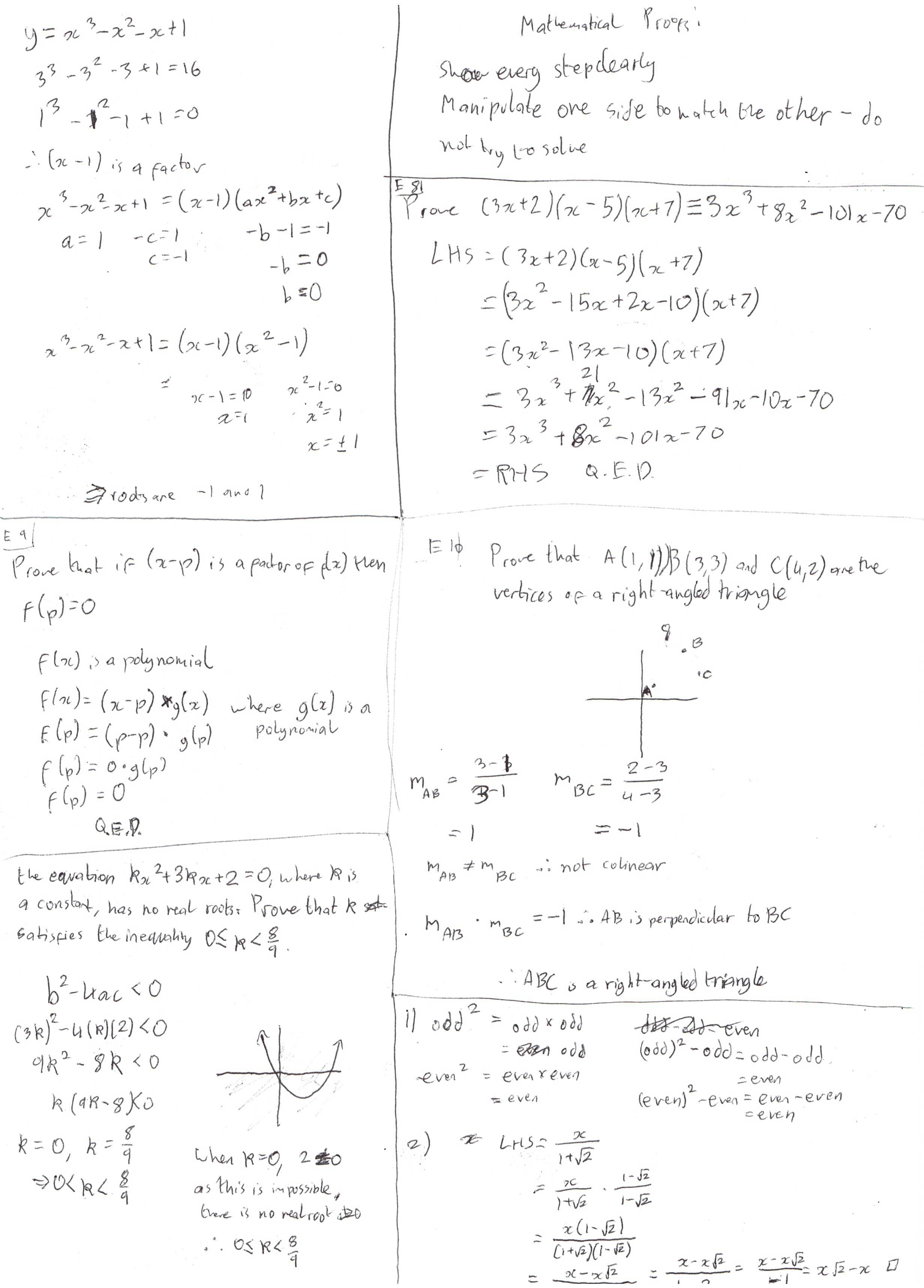
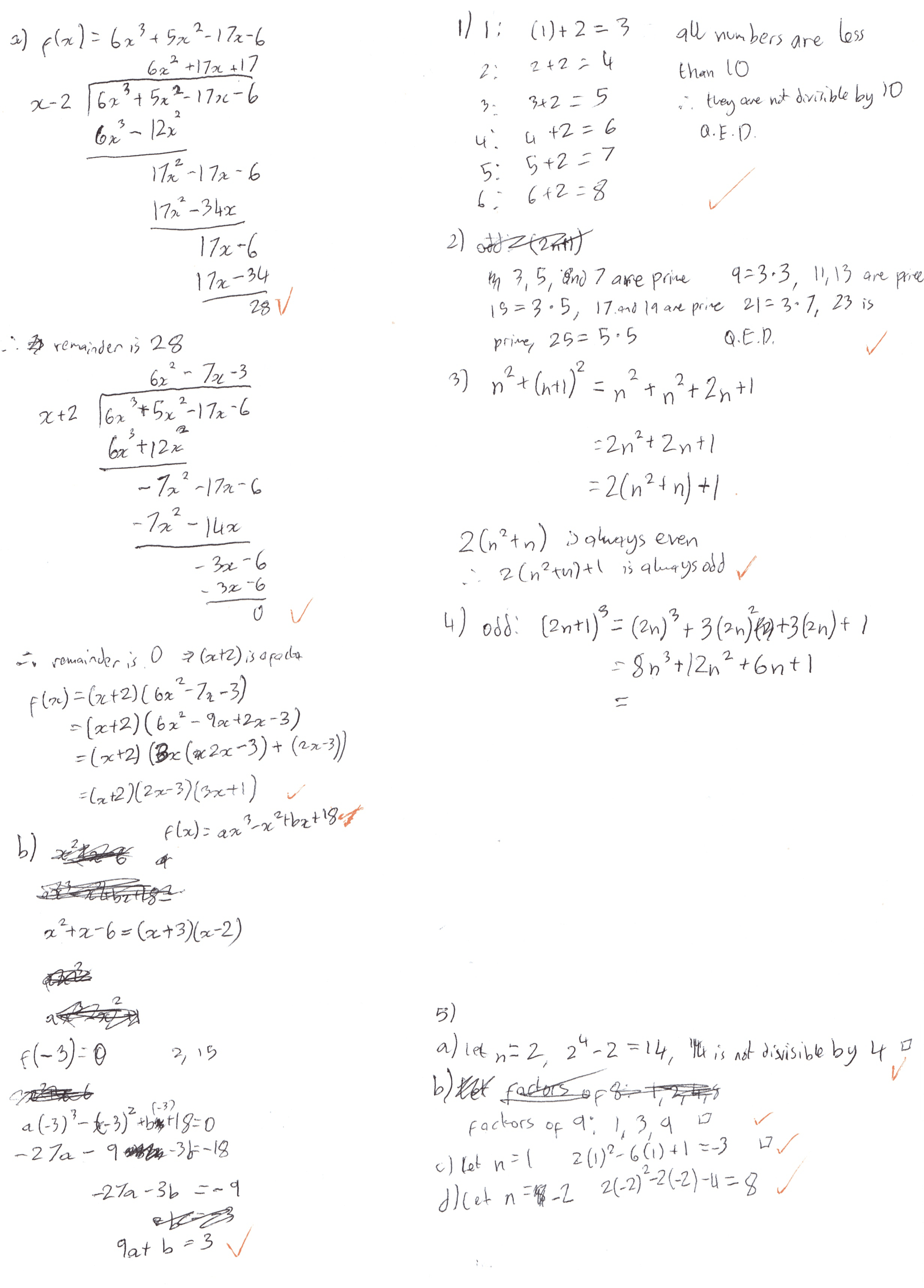
The factor theorem states that if (xp)(x-p) is a factor, f(p)=0f(p) = 0, and vice versa am-factor-theorem am-factor-theorem-2

Mathematical Proof

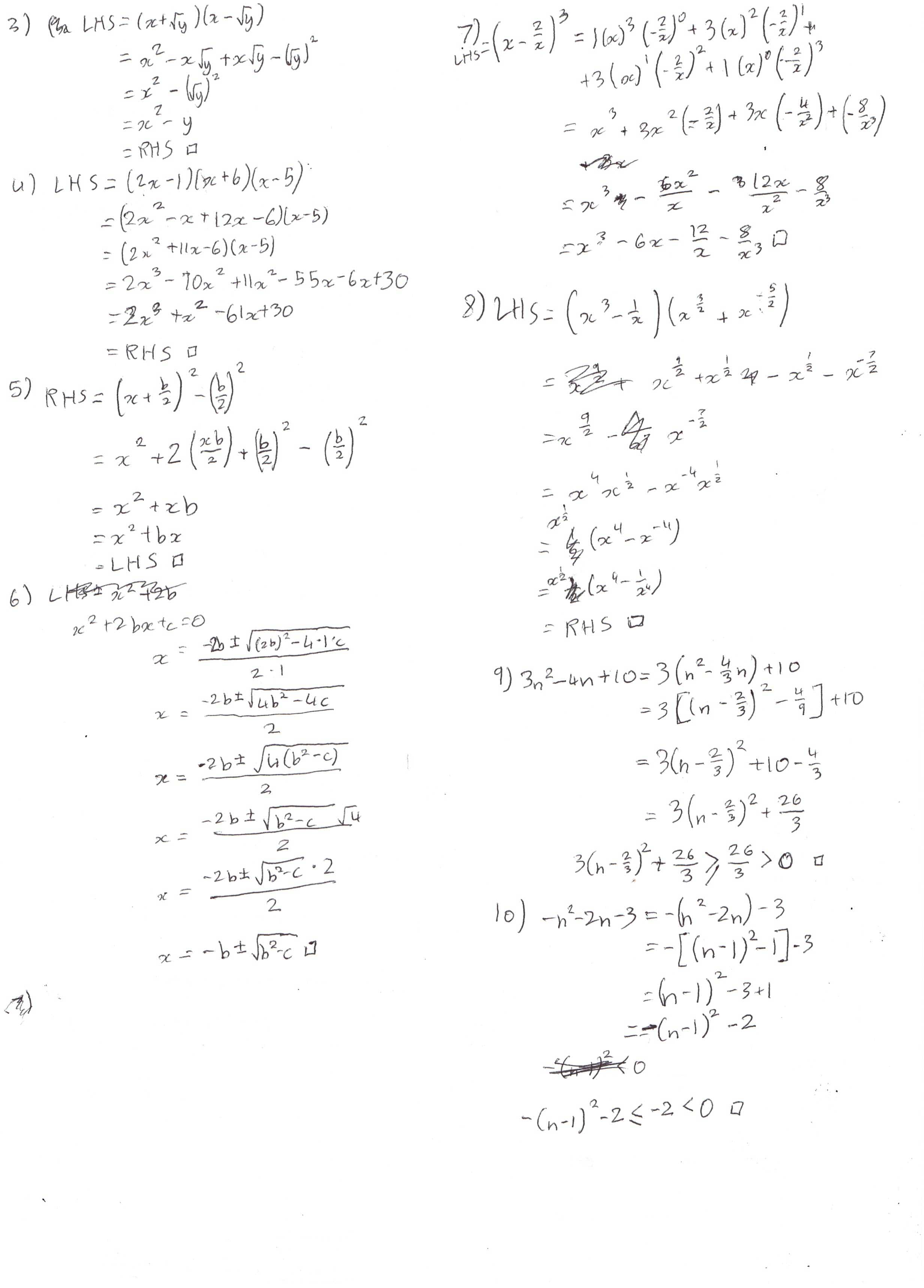
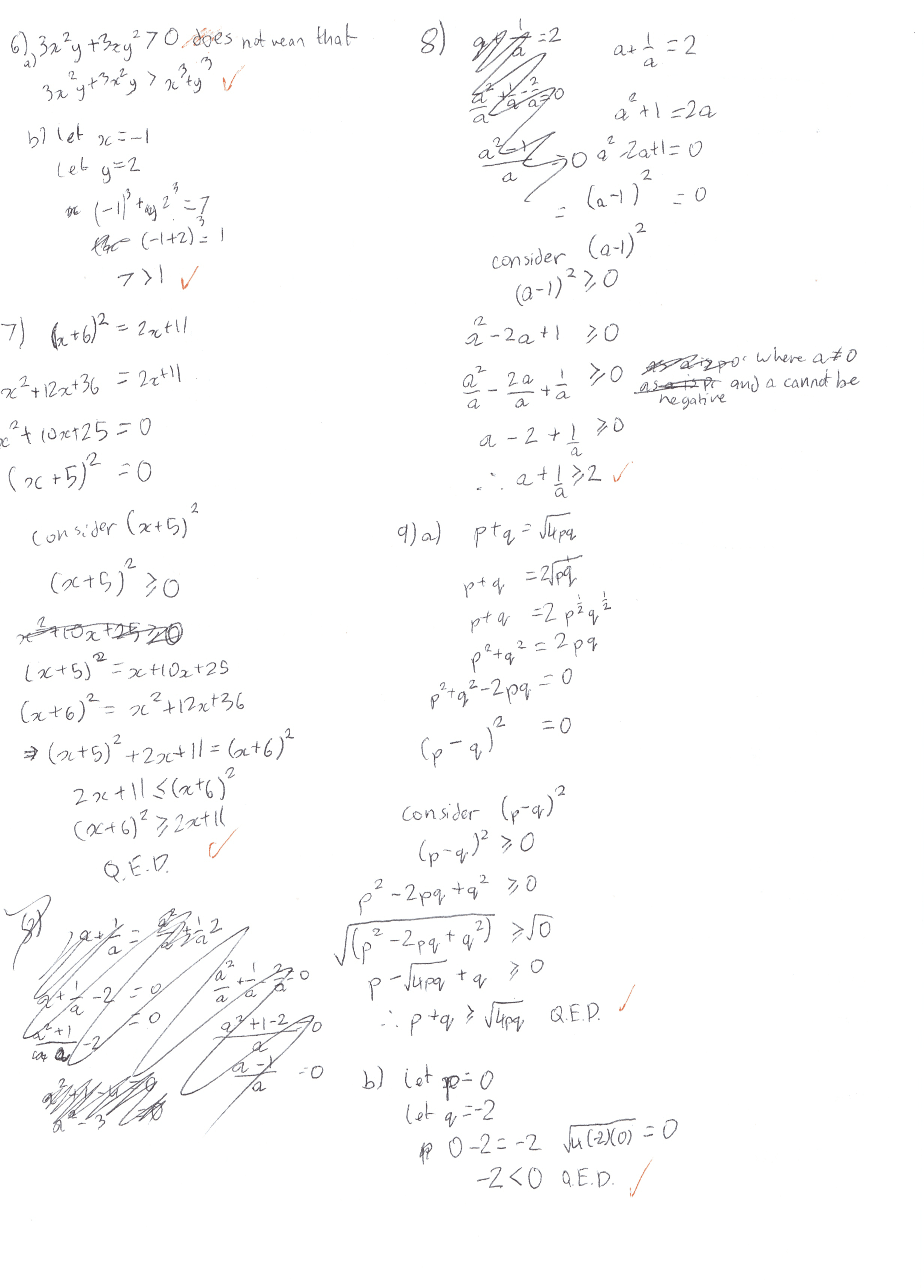
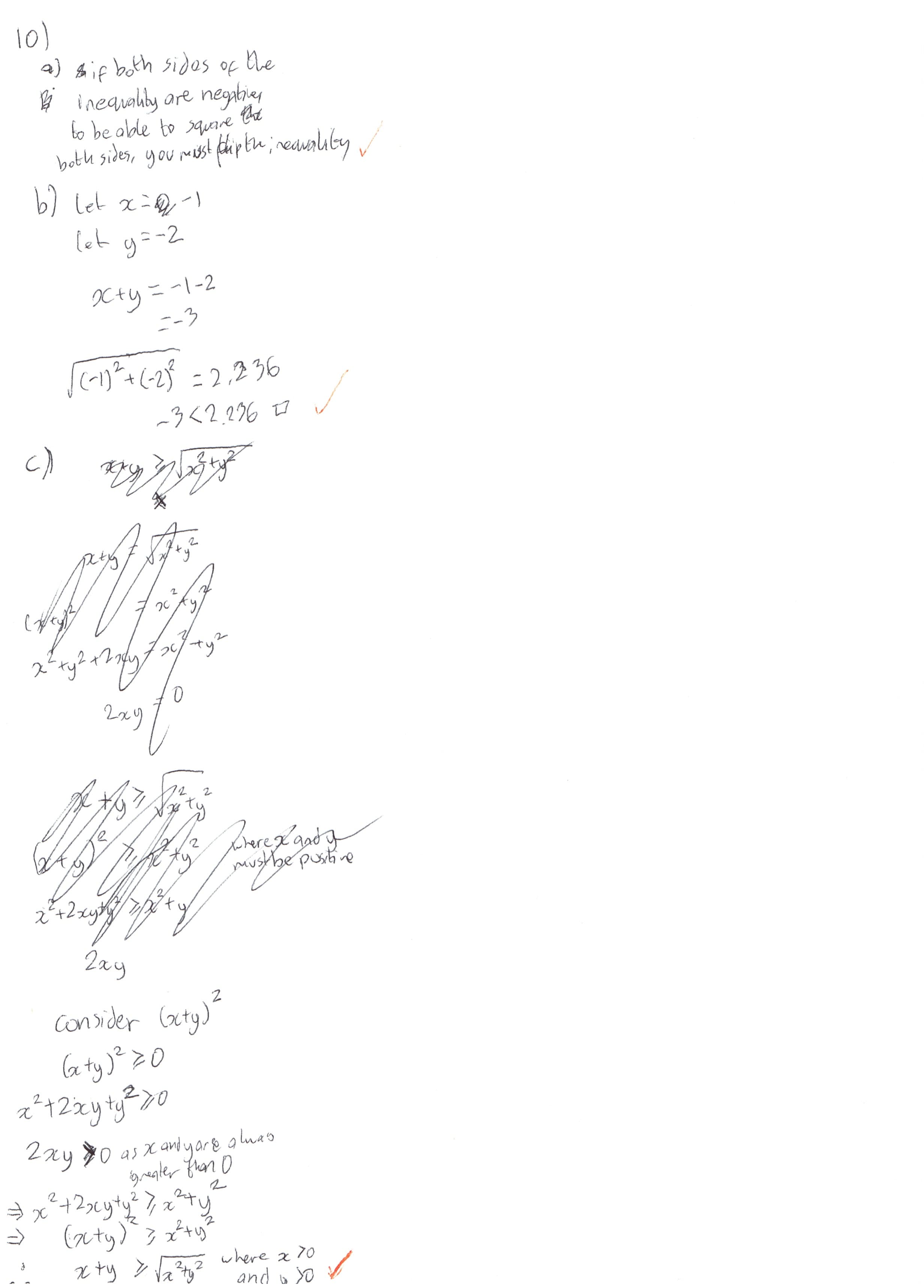
am-proof-1 am-proof-2 am-proof-3 am-proof-4

Methods of Proof

  • Exhaustion
    • Break down into smaller cases and prove individually to prove a statement
  • Counter-example
    • Use one example to disprove a statement

Example 12

Prove that all square numbers are either a multiple of 4 or 1 more than a multiple of 4

Odd case(2n+1)2=4n2+4n+1=4(n2+n)+1    One more than a multiple of 4Even case(2n)2=4n2    Multiple of 4Q.E.D.\begin{align} \text{Odd case} \\ (2n+1)^2 &= 4n^2 + 4n + 1 \\ &= 4(n^2+n) + 1 \\ \implies \text{One more than a multiple of 4} \\ \\ \text{Even case} \\ (2n)^2 = 4n^2 \\ \implies \text{Multiple of 4} \\ \\ \text{Q.E.D.} \end{align}

Example 13

Prove that the following statement is not true:

The sum of two consecutive prime numbers is always even

2+3=5 which is not evenQ.E.D.\begin{gather} 2 + 3 = 5\text{ which is not even} \\ \text{Q.E.D.} \end{gather}

Example 14

Prove that for all positive values of xx and yy:

xy+yx2\frac{x}{y} + \frac{y}{x} \geq 2 xy+yx=2x2+y2xy=2xyx22xy+y2=0(xy)2=0consider (xy)2(xy)20x22xy+y20x22xy+y2xy0 where xy0 and xy cannot be negativexy2+yx0(xy+yx)20xy+yx2\begin{align} \frac{x}{y} + \frac{y}{x} &= 2 \\ \frac{x^2 + y^2}{xy} &= 2xy\\ x^2 - 2xy + y^2 &= 0 \\ (x-y)^2 &= 0 \\ \\ \text{consider }(x-y)^2 \\ (x-y)^2 &\geq 0 \\ x^2 - 2xy + y^2 &\geq 0 \\ \frac{x^2 - 2xy + y^2}{xy} &\geq 0\text{ where } xy \neq 0\text{ and $xy$ cannot be negative} \\ \frac{x}{y} - 2 + \frac{y}{x} &\geq 0 \\ \left( \frac{x}{y} + \frac{y}{x} \right) - 2 &\geq 0 \\ \therefore \frac{x}{y} + \frac{y}{x} &\geq 2 \end{align}

Use a counter-example to show that this is not true when xx and yy are not both positive

Let x=1, y=212+21=12+21=122=52Q.E.D.\begin{align} \text{Let }x=-1,\ y=2 \\ \frac{-1}{2} + \frac{2}{-1} &= -\frac{1}{2} + -\frac{2}{1} \\ &= -\frac{1}{2} - 2 \\ &= -\frac{5}{2} \\ \text{Q.E.D.} \end{align}

am-mproof-1 am-mproof-2 am-mproof-3

Built with LogoFlowershow